


Biodiversity Concerns All Inhabitants of the Earth

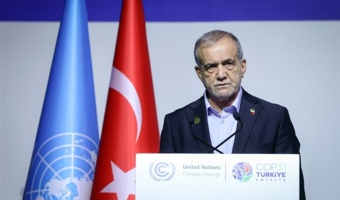
Masoud Pezeshkian, speaking at the Leaders' Summit of the 17th Conference of the Parties to the Convention on Biological Diversity, held in Yerevan, described war not only as a threat to human lives and infrastructure but also as a direct cause of the destruction of nature. He stated that war burns forests, destroys wetlands, contaminates soil and water, and displaces wildlife species.
The President described environmental cooperation as a bridge between nations and stated: "We believe that biodiversity conservation can be one of the important areas of 'peace diplomacy.' In a region facing security crises resulting from the illegal and expansionist presence of powers, climate change, water scarcity, and ecosystem degradation, environmental cooperation can build a bridge between nations—a bridge that paves the way toward peace and security for all, peace with nature, and a future in which life is in harmony with nature."
The full text of President Pezeshkian's speech at the summit is as follows:
In the Name of Allah, the Most Compassionate, the Most Merciful
Your Excellency Mr. Pashinyan, Mr. Secretary-General;
Your Excellencies, Distinguished Heads of Government and Delegations;
Distinguished Executive Secretary of the Convention on Biological Diversity;
Ladies and Gentlemen;
First, I would like to express my appreciation to His Excellency Mr. Nikol Pashinyan, the distinguished Prime Minister, and the Government and people of the friendly and neighboring Republic of Armenia for hosting this important event and for the invitation extended to us.
It is a pleasure for me to be among the global family of the Convention on Biological Diversity, which regards the protection of nature as the protection of humanity's future. Today, we stand at a point in history where biodiversity is no longer merely a scientific or environmental issue; rather, it is a matter related to peace and security, health, food and water security, and intergenerational justice for all inhabitants of the Earth.
The Islamic Republic of Iran was among the first countries to recognize the legal and international importance of this issue and to become a party to the Convention on Biological Diversity. However, Iran's relationship with biodiversity is not limited to the history of our accession to an international convention.
Iran, with its ancient tradition of living in harmony with nature and its remarkable diversity of ecosystems, species, and genetic resources, is the inheritor of a valuable and irreplaceable heritage. This heritage is the result of millions of years of evolution, dynamism, and adaptation in nature and is also reflected in the culture, customs, livelihoods, indigenous knowledge, and historical identity of the people of this land.
Due to its exceptional geographical location, Iran lies at the intersection of various biogeographical regions. From the Hyrcanian and Arasbaran forests to the Zagros Mountains, from arid and desert regions to the coasts of the Persian Gulf, the Sea of Oman, and the Caspian Sea, these areas are home to thousands of valuable plant and animal species and genetic resources. They form the foundation of the land's sustainability and provide a solid basis for ensuring water, food, health, biosecurity, resilience against natural hazards, and the country's sustainable development.
In Iran, biodiversity, alongside climatic and geographical diversity, is intertwined with human history and civilization. Friendship with, respect for, and protection of nature are part of the cultural, religious, and traditional identity of Iranians. Nature has always been regarded as an integral part of human life and a trust to be preserved for future generations. Many traditional ways of life, agricultural and livestock practices, uses of medicinal plants, and forms of indigenous knowledge among the Iranian people have developed throughout history based on an understanding of and adaptation to nature, reflecting thousands of years of interaction between humans and the natural environment.
For this reason, biodiversity conservation for Iran is not merely about protecting species and their habitats; it is about safeguarding a natural, cultural, and civilizational heritage.
In my country, drawing upon a long-standing culture of respect for nature and in line with national and global goals and commitments, the National Biodiversity Strategies and Action Plan has been developed and approved. The Department of Environment has been designated as the national coordinating body, and a mechanism for non-governmental participation, with priority given to local communities, has also been approved by the Government. The protection of threatened species and the restoration of vulnerable populations, including through the expansion of protected areas and monitoring of key wildlife species, are among our fundamental priorities.
Ladies and Gentlemen;
Today, I consider it necessary to address an issue that cannot be overlooked in the global discussion on biodiversity.
War.
War does not target only human beings and economic infrastructure. War also damages nature; it burns forests, destroys wetlands, contaminates soil, threatens water resources, eliminates habitats, displaces wildlife species, and introduces chemicals and heavy metals into natural cycles. The environmental impacts of war can persist for years after hostilities have ended.
Today, the international community is well aware that environmental destruction during armed conflicts is not a minor or insignificant side effect of war. Such damage is directly linked to the security and well-being of future generations.
In our region, including Iran, the environmental consequences of military conflicts must receive greater attention from the international community. The war of aggression launched by the United States and the Zionist regime in our region has damaged industrial and energy facilities, caused fires, released pollutants, contaminated soil and water, threatened natural ecosystems, and destroyed conservation infrastructure developed through years of efforts to protect biodiversity.
This is not merely a domestic issue or one confined within the political borders of a country. Nature recognizes no political boundaries, and the spread of water, soil, and air pollution does not stop at national borders. Therefore, the damage caused by war is also a global issue requiring international solutions.
The effects of war on ecosystems may persist for years or even generations and extend for many kilometers beyond the areas directly affected. One example is the scale of destruction inflicted upon the oppressed people of Gaza, where, according to experts, parts of the soil may remain incapable of supporting life and natural ecological and plant cycles for hundreds of years. What has occurred in our region as a result of wars of aggression is "ecocide or environmental genocide," which must be condemned.
The international community is expected to establish effective, transparent, and enforceable mechanisms to protect natural heritage and biodiversity. No country should regard nature as a silent and defenseless victim during wartime.
Ladies and Gentlemen;
The Islamic Republic of Iran considers itself committed to implementing the Convention on Biological Diversity and achieving global nature conservation goals. In Iran, we pursue the protection of natural areas, wetlands, forests, rangelands, wildlife habitats, and genetic resources alongside sustainable development.
However, we must be realistic and fair. A country that faces, on the one hand, pressures arising from climate change, drought, water scarcity, desertification, and the depletion of natural resources, and on the other hand, the effects of economic sanctions and restricted access to technology and financial resources, and that has, for two consecutive years, been subjected to criminal wars involving the widespread use of destructive and prohibited weapons, in many cases with the deliberate aim of damaging the environment, such as the attacks on fuel storage facilities in the capital, needs genuine cooperation from the international community to implement environmental programs and compensate for the damage inflicted.
Biodiversity conservation, without adequate financial resources, equitable access to knowledge and technology, and capacity-building, will remain limited to negotiations, the adoption of resolutions, and the setting of targets.
If we expect developing countries to protect their forests, wetlands, species, and genetic resources, we must also provide them with access to the tools necessary to fulfill this responsibility. This is the true meaning of environmental justice.
We believe that biodiversity financing must be more accessible, more equitable, and better aligned with the actual needs of developing countries.
Furthermore, the transfer of advanced technologies, capacity-building, the development of indigenous knowledge, and the participation of local communities must be at the center of efforts to implement the Convention's commitments.
The international community must acknowledge that countries subject to economic sanctions or military aggression should not have to bear alone the environmental costs of sanctions or wars they did not initiate.
Therefore, we call upon United Nations agencies, international financial institutions, and relevant organizations and bodies working in the fields of environment and sustainable development to strengthen mechanisms for mobilizing financial resources, assessing environmental damage, restoring degraded ecosystems, and supporting affected countries in addressing the environmental consequences of armed conflicts.
Distinguished Participants;
Saving the planet and protecting the environment require a shared understanding among all of us of the challenges facing humanity and the responsible use of diverse solutions. These solutions must take into account different national circumstances, priorities, capacities, and pathways and must not impose additional burdens on developing countries. Rather, they should provide the necessary resources and opportunities for these countries to protect nature while achieving sustainable development.
The Islamic Republic of Iran stands ready to share its scientific and academic capacities and experiences with other countries and to cooperate constructively with the international community in this collective effort.
We believe that biodiversity conservation can be one of the important areas of "peace diplomacy."
In a region facing security crises resulting from the illegal and expansionist presence of powers, climate change, water scarcity, and ecosystem degradation, environmental cooperation can build a bridge between nations—a bridge that paves the way toward peace and security for all, peace with nature, and a future in which life is in harmony with nature.
A future free from war, killing, and destruction, in which biodiversity serves as a common foundation for the well-being and prosperity of present and future generations.
Thank you for your attention.

Your Comment :