


Dr. Aflatouni:
Attack on the Natural Resources Organization Is a Clear Violation of Human Rights

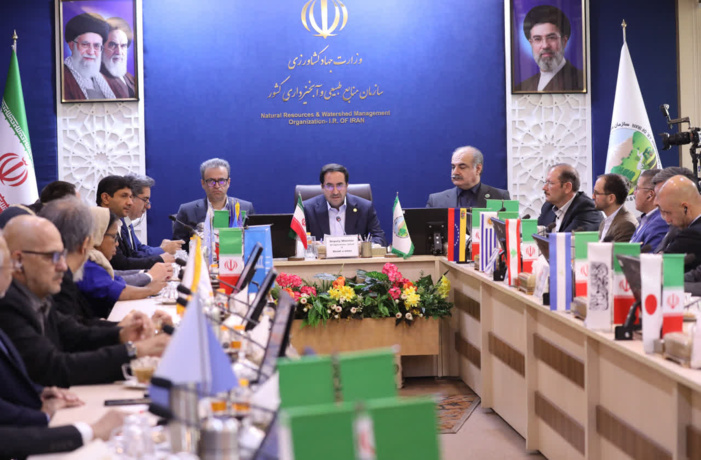
Dr. Reza Aflatouni hosted ambassadors and representatives of international organizations residing in Iran on Monday morning to visit the sites damaged during the Third Imposed War at the Natural Resources Organization.
At noon on March 28, 2026, military forces of the United States and the Zionist regime carried out a targeted and deliberate air attack on the organization, resulting in the martyrdom of a number of dedicated colleagues, experts and managers, including Martyr Brigadier General Majid Zekriyaei, Commander of the Natural Resources and Watershed Management Protection Unit, as well as Martyrs Seyed Saeed Mousavi-Nejad Naini, Davoud Omrani, Morteza Maqsoudi, Ali Montazeri and Asghar Meshkani.
Following this incident, the Head of the Natural Resources and Watershed Management Organization repeatedly condemned the attack and sent correspondence to international organizations.

The Natural Resources Organization: Rooted in More Than a Century of History
In this regard, Dr. Reza Aflatouni, Head of the Natural Resources and Watershed Management Organization, said in a meeting with ambassadors from more than ten countries and representatives of specialized international organizations: “The roots of this organization go back to more than a century of systematic efforts to safeguard Iran’s natural assets. With the adoption of the Law on the Nationalization of Forests and Rangelands and the Law on the Protection and Utilization of Forests and Rangelands, a new chapter began in the governance of the country’s natural resources.”
The Deputy Minister of Jihad-e Agriculture continued: “This path continued after the victory of the Islamic Revolution of Iran through the formulation and implementation of fundamental laws, including the General Policies of the System in the natural resources sector, the Law on Increasing Productivity in Agriculture and Natural Resources, the Soil Protection Law, and the revision of upstream documents in the agriculture and natural resources sectors. Today, this path is being pursued within the framework of the Seventh Development Plan, with a new and forward-looking approach.”
He stated: “Today, the Natural Resources and Watershed Management Organization, as the custodian of the protection, restoration, development and sustainable utilization of Iran’s forests, rangelands, deserts and watersheds, plays a strategic role in enhancing biological security, food security, land resilience against climate change, combating desertification, sustainable water and soil management, and supporting the livelihoods of local communities.”
The Deputy Minister of Jihad-e Agriculture emphasized: “The implementation of national watershed management and aquifer management projects within the framework of comprehensive and health-oriented watershed management, the public campaign to plant one billion trees, the protection of the Hyrcanian forests and social forestry in the Zagros region, increasing the protection coefficient of coastal, mountainous and desert ecosystems, rangeland restoration and development, reducing water and wind erosion of soil, and strengthening the participation of citizens, villagers and nomadic communities are among the most important priorities of this organization in the new period. These priorities are pursued within the framework of our national documents, in alignment with the objectives of global sustainable management, and are emphasized by international institutions related to renewable natural resources.”
The Natural Resources Organization: Active in International Cooperation
He said: “Alongside its national role in protecting and restoring natural resources, the Natural Resources and Watershed Management Organization has also had an active and responsible presence at the international level in achieving the objectives of environmental conventions. Given that the Islamic Republic of Iran is located in the world’s arid and semi-arid belt and directly faces challenges such as desertification, floods, soil erosion, drought, pests and diseases, widespread fires and climate change, it has played an effective role in programs to combat desertification, especially the Land Degradation Neutrality programme. Iran has sought to use the capacity of the National Focal Point of the United Nations Convention to Combat Desertification and Drought in the Islamic Republic of Iran, the Global Secretariat of Low Forest Cover Countries, and the International Centre on Integrated Management of Watershed and Bioresources under the auspices of UNESCO to present a regional model of sustainable land management.”
Aflatouni noted: “Iran’s unique ecological capacities, from the Hyrcanian forests registered on the UNESCO World Heritage List to the valuable mangrove forests on the country’s southern coasts and the oak forests of the Zagros, demonstrate the global importance of Iran’s biosphere reserves. Protecting these assets is not only a national responsibility, but also an enduring cultural and scientific commitment of the Iranian people and a legacy inherited from the ancestors of this land for the protection of the planet.”
He added: “In this regard, extensive and fruitful cooperation with institutions such as UNDP, UNESCO, FAO and APDIM, as well as regional and international natural resources programmes, has provided the ground for the transfer of knowledge and lessons learned, the development of modern technologies, the implementation of joint projects, and the strengthening of the environmental and nature-based diplomacy of the Islamic Republic of Iran. Today, we believe that protecting natural resources is not merely an organizational mission, but part of the shared global responsibility to safeguard the future of humanity and future generations.”
Attack on the Natural Resources Organization: An Attack on a Scientific, Civilian and Cultural Institution
The Deputy Minister of Jihad-e Agriculture added: “Today, we are standing on ground that bears the wound of an unforgivable act; an attack that targeted not only several buildings, but also the very principles for which international agencies and institutions were established: the sanctity of knowledge, the protection of the shared cultural and natural heritage of humanity, and the universal right to access a sustainable future. Although the imposed war caused serious damage and material loss at this site, it has made the will of the servants of Iran’s natural resources to protect Anfal, natural heritage and the rights of future generations stronger and more determined.”
He stated: “On Saturday, March 28, 2026, the military forces of the United States and the Zionist regime carried out a targeted air attack on the Natural Resources and Watershed Management Organization of Iran. This was a deliberate assault on a scientific, civilian and cultural institution. The administrative building for education and extension, the Public Relations and International Affairs Office of the organization, the valuable Museum of Iran’s Ancient Natural Resources History, the organization’s library, and the Protection Unit building were hit and destroyed. Yet, most painfully, as a result of this attack, a number of dedicated colleagues, experts and committed managers of this organization were martyred. We mourn the martyrdom of these devoted colleagues and committed servants of nature, including the Commander of the Natural Resources Protection Unit and other forces who were on standby during the Nowruz holidays to protect our forests and rangelands against fire and destruction. It is clear that this was not a military zone. They were only guardians of forests and rangelands and protectors of national and global natural heritage.”
Aflatouni added: “This attack also specifically destroyed the Governing Council Hall of the International Centre on Integrated Management of Watershed and Bioresources under the auspices of UNESCO, known as ICIMWB, where many of you, our esteemed guests, have been present in recent years within this very organization. Since 2021, this centre has been operating directly under this organization and under the auspices of UNESCO to advance research, education and international cooperation in sustainable land management in the dry and semi-dry regions of the world, seeking solutions based on global partnership and awaiting your cooperation in its Governing Council.”
Attack on the Natural Resources Organization: A Blow to the International Community in Confronting Shared Climate Crises
He continued: “This loss is not only for the Islamic Republic of Iran; it is a blow to the entire international community, which relies on scientific, comprehensive and multilateral frameworks to confront shared climate crises and safeguard renewable natural resources and the global environment.”
The Head of the Natural Resources Organization said: “Targeting a civilian scientific and environmental organization is a clear violation of international humanitarian law and the principles enshrined in the Geneva Conventions, the 1954 Hague Convention for the Protection of Cultural Property, respect for scientific, executive and cultural memoranda of understanding among friendly countries, and the foundational documents of international institutions such as UNESCO.”
He stated: “The Additional Protocols to the Geneva Conventions explicitly protect civilian objects, including buildings dedicated to scientific, educational and humanitarian purposes. In addition, the 1954 Hague Convention was the first global convention devoted exclusively to the protection of cultural and scientific heritage during armed conflicts.”
Attack on the Natural Resources Organization: A Violation of Human Rights
Aflatouni emphasized: “This aggression by the Zionist regime and the United States against Iran and the Natural Resources and Watershed Management Organization is itself a clear violation of Article 2, paragraph 4, of the Charter of the United Nations and an act of aggression. From various aspects, it is contrary to international treaties and conventions. Since 2001, the United Nations has designated November 6 as the International Day for Preventing the Exploitation of the Environment in War and Armed Conflict, with the aim of drawing greater attention to the obvious and hidden risks of wars for the long-term destruction of ecosystems and environmental resources. Yet, in these inhumane and unjustifiable aggressions against the territorial integrity of our country, Iran, serious damage has been inflicted on the environment and natural resources of Iran.”
According to him, “The attacks by the United States and the Israeli regime on our nuclear facilities constitute a flagrant violation of the Non-Proliferation Treaty and UN Security Council Resolution 2231, because attacks on such facilities are absolutely prohibited under international law, including IAEA Resolution 533 and UN Security Council Resolution 487. Although the Blue Shield is the official emblem of the 1954 Hague Convention for the Protection of Cultural Property in the Event of Armed Conflict, and its installation at historical sites serves as a reminder of the global responsibility toward human heritage, we have witnessed the destruction of more than 149 historical sites and 54 museums, including Golestan Palace, the historic Chehel Sotoun Palace in Isfahan, Naqsh-e Jahan Square in Isfahan, Falak-ol-Aflak Castle in Khorramabad, and other historical sites of this ancient land.”
Attack on the Natural Resources Organization: A Clear Example of Eco-Terrorism
The Head of the Natural Resources Organization said: “This organization is an executive, specialized, technical and scientific institution responsible for the protection of renewable natural resources, forests and rangelands. An attack on such an institution cannot be justified under any logic of international law or humanitarian principles. This act is not only a violation of national sovereignty and the Charter of the United Nations, but also a clear example of a phenomenon that must be called ‘eco-terrorism’; a serious obstacle to the realization of humanity’s collective commitments to protect the planet. As has previously been stated in international forums: ‘Knowledge knows no borders, and harming it is harming the shared future of humanity.’”
We Demand Global Justice and Accountability
He added: “Despite this tragedy, the determination of Iran’s scientific and environmental community, as well as the hopeful outlook of the experts and managers of the Natural Resources and Watershed Management Organization, has never been shaken. We will continue our ‘green path’ with the iron will of the people.”
Aflatouni stated: “However, we are not thinking only about rebuilding the damage and destruction, although that is very important. We demand global justice and accountability.”
He emphasized: “The Islamic Republic of Iran has conveyed its official protest to the relevant bodies of the United Nations, including UNESCO, UNDP, FAO and the Secretariat of the United Nations Convention to Combat Desertification, and has explicitly called for a clear and unequivocal condemnation of this terrorist act.”
The Deputy Minister of Jihad-e Agriculture, in inviting ambassadors and representatives of international organizations residing in Iran to visit the destruction caused to the organization, called on them to:
-
Firmly and unequivocally condemn the deliberate targeting of our scientific institution and the killing of the staff of the Natural Resources Organization, with the same force and clarity sometimes applied to other attacks on educational and cultural sites around the world.
-
Initiate an independent investigation led by UNESCO, in accordance with its mandate to protect scientific institutions, and by other international agencies and institutions regarding the environmental damage caused, in order to fully document the violations of international law committed against this organization and its staff, and to ensure that these findings serve as a basis for accountability.
-
Commit to the reconstruction of the ICIMWB Governing Council Hall, the Museum of Iran’s Ancient Natural Resources History, and the organization’s library as a symbol of international solidarity and a renewed affirmation that violence cannot break the bonds of scientific cooperation.
-
Strengthen the application of existing international legal instruments, including the 1954 Hague Convention and the Geneva Conventions, to ensure that scientific, nature-based and environmental institutions receive the firm protection they deserve, and that the emerging legal concept of “eco-terrorism” is officially recognized within the frameworks of UNESCO and other international institutions and pursued by ambassadors and representatives of embassies.
The Deputy Minister of Jihad-e Agriculture also emphasized solidarity for the shared heritage of humanity, saying: “We thank you for your valuable presence and responsible approach in this programme, as you stood alongside the great family of the organization’s martyrs, alongside the scientific community, and in support of the foundations, institutions, and cultural and scientific goals.”
He added: “Let this tragedy and the suffering of our civilized and cultured people become a turning point not only for Iran, but for the entire international community. Let us rebuild together, in cooperation and shared understanding, not only structures of brick and cement, but also the structures of justice, accountability and unwavering commitment to protecting our planet and protecting those who devote their lives to guarding it and each of its trees.”
Aflatouni concluded: “As always, the blood of our martyred colleagues has once again watered the seed of an ancient and firm resolve along the path of the will of the nation and the civilization of Islamic Iran. We will continue to protect the soil, water, forests and rangelands — for Iran, for the region, and for the world.”

Your Comment :